
Do you remember the first time someone handed you a handwritten letter? Not a text, not a printed card — an actual letter, written in looping, flowing cursive by someone who took the time to sit down and put pen to paper just for you? There's something about that moment that's impossible to replicate digitally. The curves of their letters, the way their hand pressed a little heavier on certain words — it's a window into a person that nothing else quite captures.
That's the feeling I've been chasing my whole life when it comes to handwriting. And it's exactly why I created The Cursive Connection.
A Curriculum Born Out of a Search
When I transitioned from teaching kindergarten full-time to homeschooling my own four boys here in Utah, I went looking for a cursive curriculum that actually felt worthy of the skill it was teaching. What I kept finding were endless tracing worksheets — pages and pages of repetition with no real connection to why cursive matters or where it comes from. I wanted my boys to do more than copy letters. I wanted them to understand that what they were learning had been practiced by generations before them, that real historical documents were written in this hand, that this was a living, breathing art form.
So I built what I couldn't find.
What The Cursive Connection Actually Is
The Cursive Connection is a 40-week traditional cursive handwriting curriculum rooted in the Palmer Method — the same approach that was standard in American schools for most of the 20th century. It's designed for learners aged 8 and up, which means it works beautifully for third graders just beginning cursive, but it's equally beloved by adults who never learned or who want to improve their handwriting. No prerequisites. No prior experience needed. Just a willingness to slow down and learn something genuinely beautiful.
As a certified penmanship instructor and a member of IAMPETH, I built this curriculum with both a teacher's structure and an artist's heart. The lessons progress methodically — starting with the foundational strokes and building toward flowing, connected script — but there's so much texture woven through the experience along the way. Students study historical handwriting samples through literal magnifying spectacles. They trace the laminated exemplar with a wet-erase marker before picking up their own pencil. They explore the evolution of American penmanship, from Platt Rogers Spencer to A.N. Palmer. Cursive isn't just a skill here — it becomes a story they're part of.
The Boxed Set Experience
One of the things I'm most proud of about The Cursive Connection is the boxed set. When I was designing it, I kept thinking about how special it should feel to open — because learning to write in cursive is special, and the experience should match that.
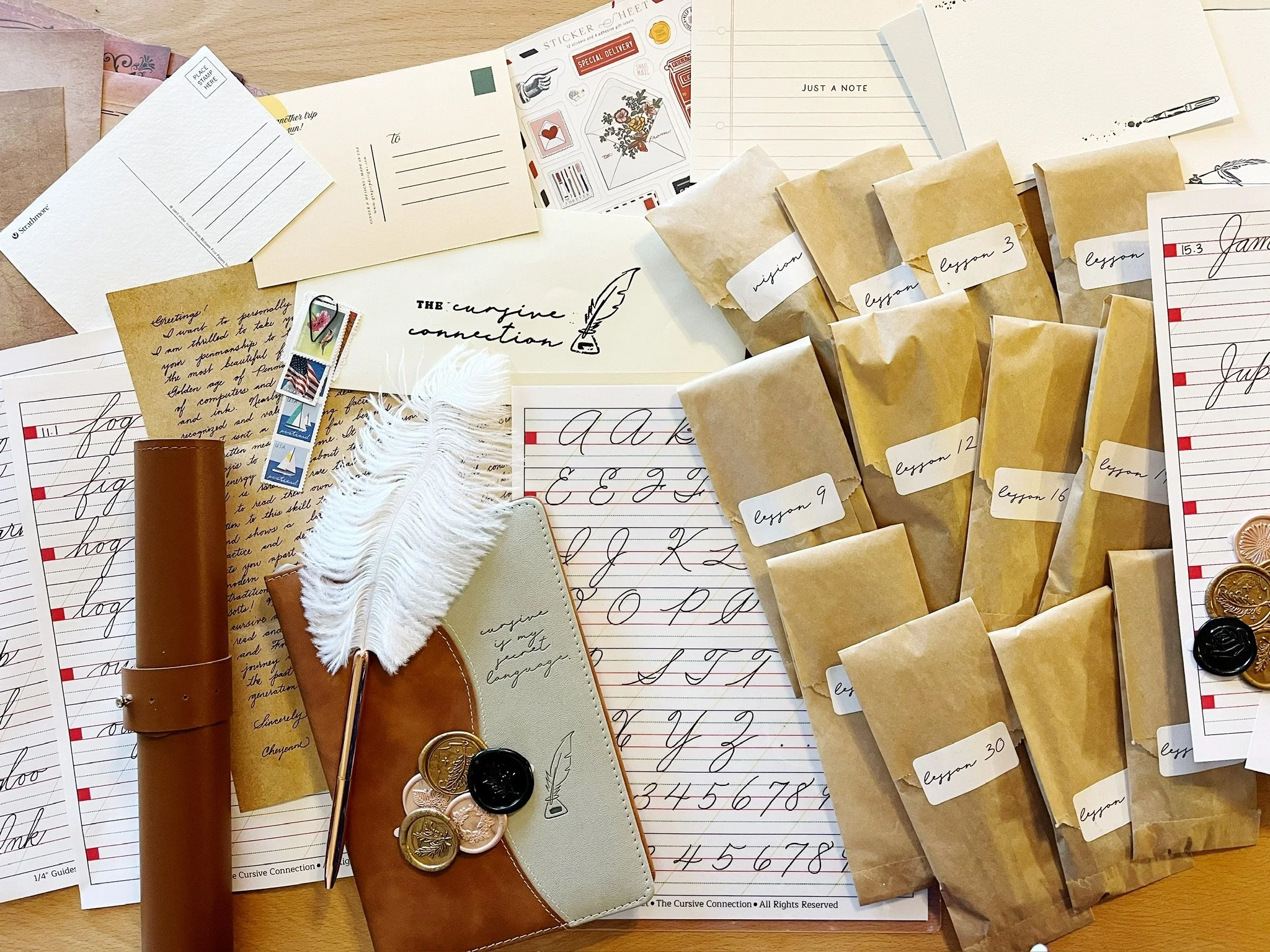
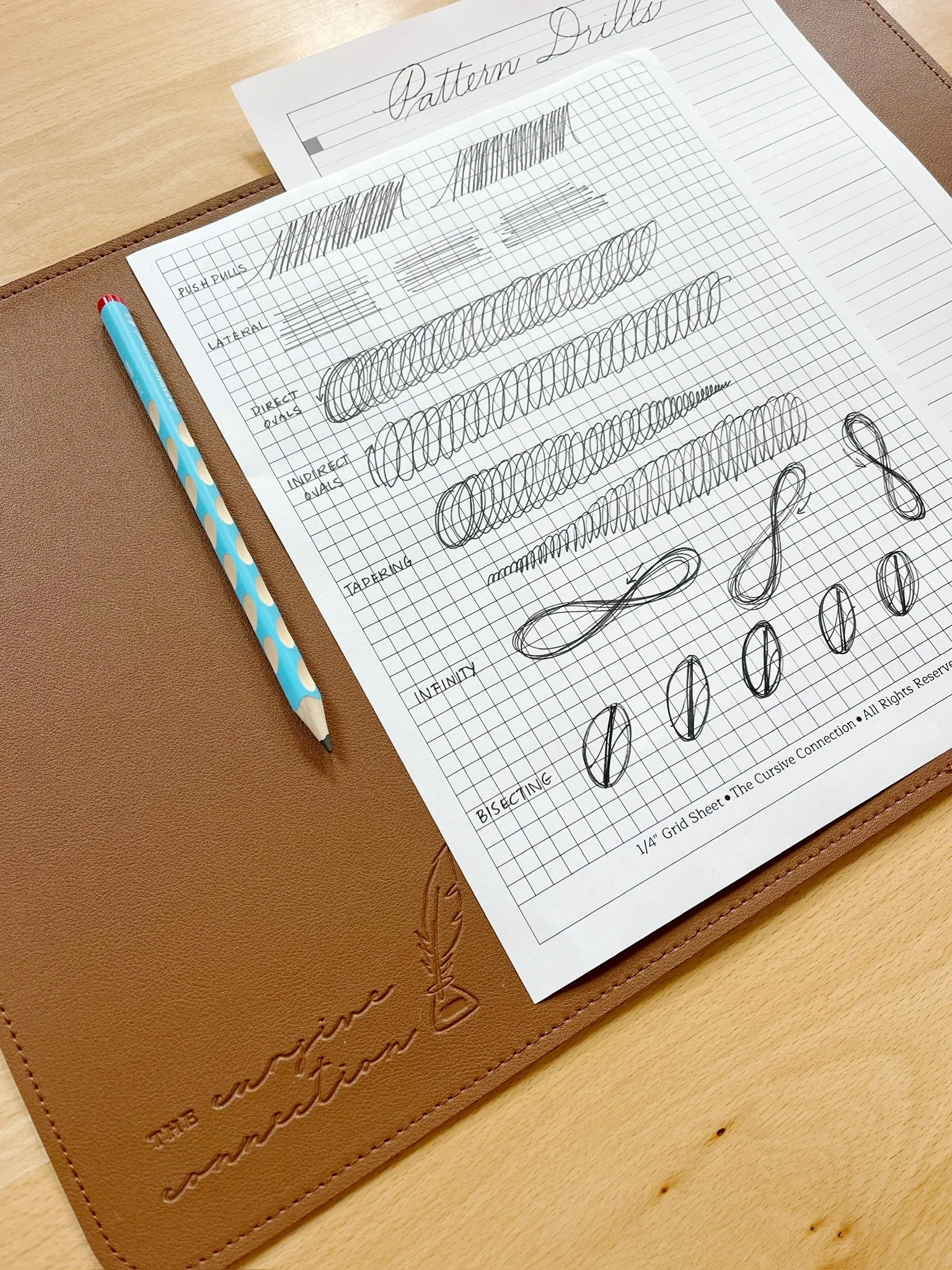
The boxed set is a grab-and-go everything package. It includes 440 pages of curriculum (a full teaching guide, reproducible blank guidesheets, weekly lesson sheets, and certification checkpoints), a laminated model exemplar, a leather desk blotter, a leather journal, and a feather quill pen. There's also a beautiful collection of vintage-themed stationery ephemera — notecards, postcards, greeting cards, wax seals, stickers, and even USPS stamps — because cursive should be used, not just practiced on worksheets. And then there are 12 surprise packages tucked into the course that students get to open along the way, filled with quality writing instruments like Stabilo and Faber-Castell pencils, Gelly Roll gel pens, a Sakura Micron, a Zebra Fountain Pen, and more. It keeps the journey exciting from week one all the way through.
All of this arrives in a sturdy storage box that keeps everything organized and feels like a true investment in the craft.
The Online Course: Flexibility for Every Learner
For families who prefer a fully digital experience — or who want to pair digital access with the boxed set — The Cursive Connection online course is available on its own as well. It includes lifetime access for your entire family (yes, all your kids!), video lessons, a digital curriculum you can print as needed, a growing historical sample library, and bonus units that go beyond basic penmanship. There's a letter writing unit because I truly believe that knowing how to write is only half the gift — knowing how to compose a meaningful personal letter is the other half. There's also a literacy unit built around the book Muggie Maggie, which is such a sweet way to weave cursive into your broader language arts experience.
The online course option starts at $179, the boxed set is also $179, and if you want the full experience with both together, the Box and Online Bundle is $239 — our best value by far.
For Homeschoolers, Classrooms, and Everyone In Between
I designed The Cursive Connection to integrate with popular homeschool curricula, so it doesn't have to stand alone in your schedule. It can stretch over one school year or two — whatever pace fits your family. Left-handed writers are fully supported throughout. And the certification process — where students submit handwriting samples at the beginning, middle, and end of the course — adds a meaningful sense of accomplishment. When a student completes all three checkpoints, they receive a beautiful, hand-addressed certificate patterned after the traditional Palmer Method. It's the kind of thing you keep.
There's also a private Facebook community for course families where students and parents share their progress, ask questions, and cheer each other on. The response from homeschool families when I launched this course was genuinely moving — seeing how quickly parents found creative ways to weave cursive into history, poetry, journaling, and letter-writing warmed my heart in ways I didn't fully anticipate.
Why Cursive Still Matters
I know the question is out there: Does cursive even matter anymore? I believe it does — deeply. Research consistently shows that the physical act of cursive writing supports cognitive development, memory retention, and even reading comprehension. For kids with dyslexia, it can actually be helpful in ways that printing is not. Beyond the brain benefits, there's something irreplaceable about being able to read and write the original documents of our history — the Constitution, personal letters from the Civil War, your grandmother's recipe card. When cursive disappears, so does our ability to access all of it.
But honestly? Beyond all the practical reasons, I just believe that a handwritten note in flowing cursive carries a weight that nothing typed ever will. Words never lose their value — especially when they're written by hand.
If you've been thinking about starting cursive for your kids, reviving it for yourself, or simply looking for a curriculum that treats handwriting the way it deserves to be treated, I'd love for you to explore The Cursive Connection. Your journey starts here.